Collaboration, Interiors and Letting Go of Control
There is a significant difference between making something for yourself and making something for someone else.
When creating artworks or experimental pieces in the studio, the process can remain highly personal. Decisions emerge instinctively. Materials are explored freely. The work evolves according to curiosity, emotion and experimentation.
But the moment a project enters an architectural or interior environment, everything changes.
Suddenly, the work exists inside a wider ecosystem of people, budgets, timelines, expectations and practical constraints. The patterned surface is no longer simply an artistic exercise — it becomes part of somebody else’s space, somebody else’s vision and somebody else’s lived experience.
Learning how to navigate that transition has been one of the most important developments within Stratum Marquetry.
Design Is Always Collaborative
One of the biggest misconceptions about creative practice is the idea of total authorship.
In reality, most meaningful design work is collaborative by nature.
Architects collaborate with engineers.
Interior designers collaborate with clients.
Manufacturers collaborate with suppliers.
Makers collaborate with materials.
As soon as our work moves into interior projects, the process becomes fundamentally collaborative too.
That means recognising that the surface itself is only one part of a much larger conversation. A wall panel may need to respond to lighting schemes, furniture palettes, circulation routes, architectural detailing or commercial requirements that exist far beyond the material itself.
Marquetry cannot exist in isolation.
It must function as part of a broader spatial language.
The Royal Albert Memorial Museum Project
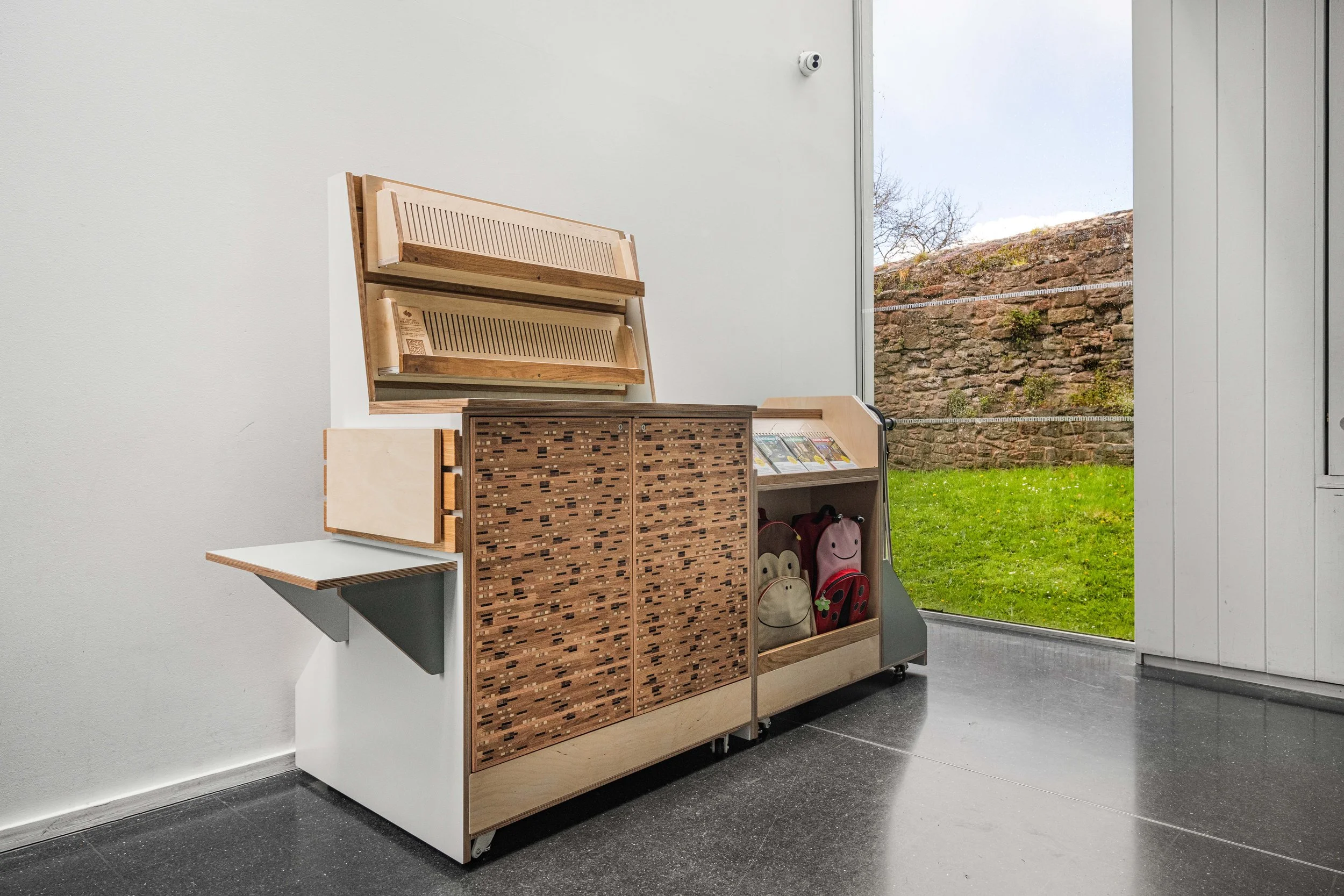
One project that highlighted this clearly was the welcome pod installation for the Royal Albert Memorial Museum in Exeter.
Although not strictly architectural in the conventional sense, the project existed fully within a public interior environment. That immediately changed the nature of the process.
Unlike artwork, where conceptual ownership largely remains with the maker, public-facing interior work requires constant dialogue. The client, the design team and the fabricators all contribute to shaping the outcome.
And importantly, ideas need translating into practical realities.
Creative teams naturally generate ambitious concepts. That is part of their role. But every concept must eventually encounter the realities of production:
Can this actually be made?
Can it be installed safely?
Can it survive heavy public use?
Can it be delivered on time?
Does it fit the budget?
The challenge becomes balancing imagination with execution.
Managing Vision
One of the most delicate aspects of collaborative work is learning how to manage vision constructively.
Everyone involved in a project brings their own expectations, references and emotional investments. Interior designers may arrive with strong aesthetic ambitions. Clients may have specific functional concerns. Architects may prioritise spatial cohesion or technical detailing.
As makers, our role often becomes interpretive.
We are helping translate ideas into physical material outcomes.
That requires a very particular kind of communication. Drawings, samples, mock-ups, sign-offs and visual references become incredibly important because they create shared understanding between all parties.
Without clarity, projects quickly become difficult.
The process is not simply about making surfaces. It is about helping people think within achievable parameters while still preserving excitement and ambition.
And that has to be done carefully and humanely.
Because ultimately, before anyone is a designer, architect or maker, they are simply people trying to work together successfully.
Letting Go Of Artistic Ownership
Perhaps the most important lesson within collaborative work is learning when to let go.
In artwork, the conceptual and emotional content often sits heavily with the maker. The work reflects personal instincts, experimentation and material exploration.
Interior projects operate differently.
At a certain point, the role of the maker shifts away from self-expression and toward service. The goal becomes helping another person realise their vision as successfully as possible.
That does not mean abandoning creativity.
It means redirecting it.
Sometimes the best outcome is not the pattern we personally would have chosen, but the pattern that best serves the wider environment and the client’s intentions.
Understanding that distinction prevents projects from becoming tangled in ego.
It also creates better relationships.
The reality is that clients are not commissioning us purely to impose ourselves artistically onto their spaces. They are commissioning us because they want expertise, material understanding and guidance in helping shape something meaningful.
That requires generosity as much as authorship.
Collaboration As Opportunity
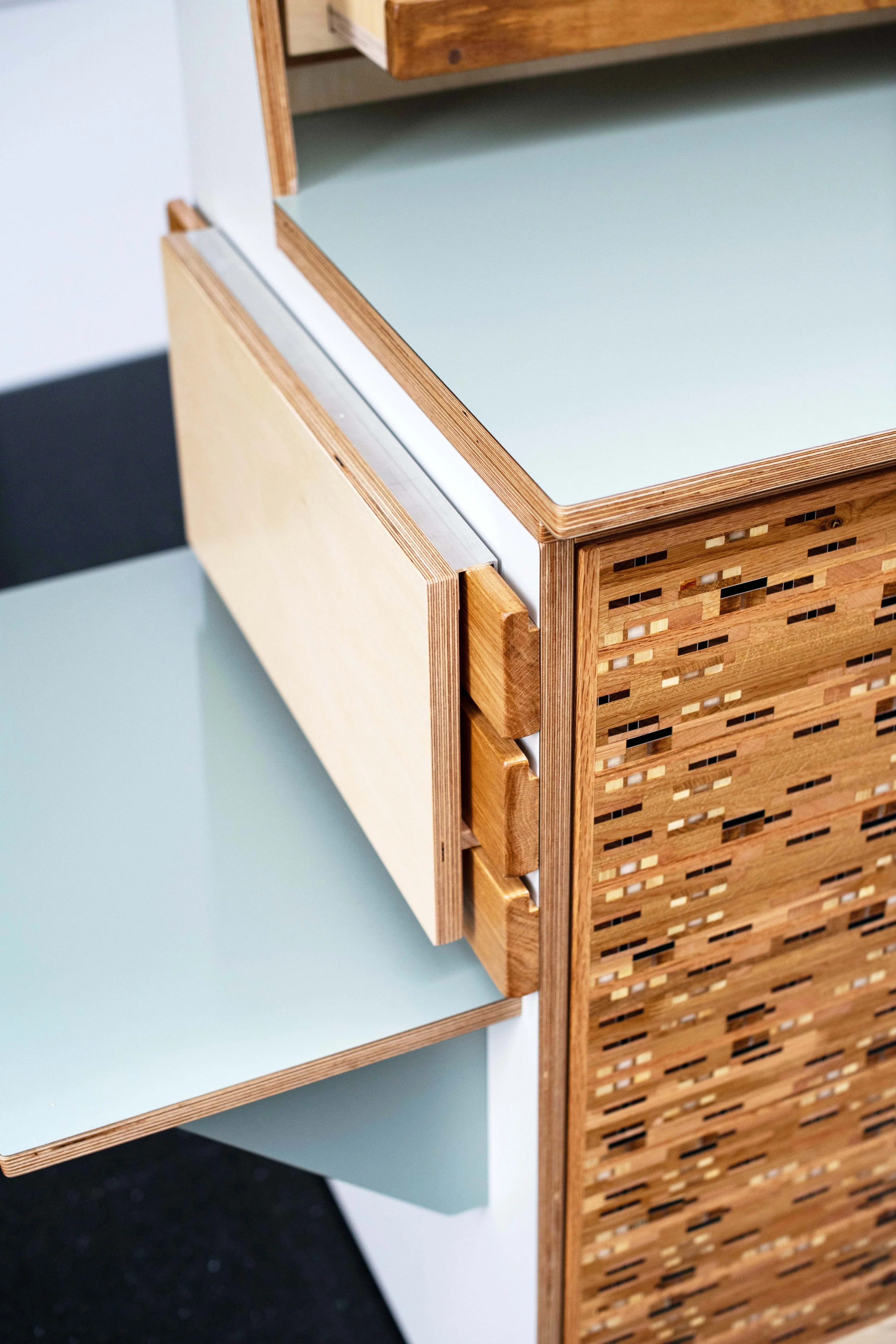
Interestingly, collaboration has also expanded our understanding of what Modern Marquetry could become.
At design fairs such as Future Icons, conversations frequently emerged with people operating in entirely different industries — automotive companies, lighting designers, furniture manufacturers and architectural studios.
Those conversations revealed something important:
The marquetry itself can function as a material ingredient rather than simply a finished object.
For example, we may be highly skilled at producing patterned composite surfaces and marquetry blocks, but another collaborator may possess advanced CNC capabilities capable of transforming those surfaces into highly complex three-dimensional forms.
That changes the relationship entirely.
Instead of trying to control every stage of production internally, collaboration allows each party to focus on its strengths.
We produce the material language.
Others manipulate it into new applications.
This feels increasingly important as the studio grows because it creates opportunities without forcing us to become experts in every possible manufacturing discipline simultaneously.
Knowing Your Limits
One of the most valuable things collaboration has taught us is the importance of recognising limitations honestly.
At events like Future Icons, it was easy to become excited by speculative possibilities. Automotive interiors. Sculptural architectural applications. Large-scale commercial installations.
Technically, almost anything is possible.
But possibility alone is not enough.
Every collaboration requires time, money, technical testing and developmental capacity. For a young studio, saying yes to everything can quickly become dangerous.
Learning to identify which opportunities genuinely align with current capabilities has become essential.
Sometimes the most responsible answer is:
“We can contribute to this specific part of the process exceptionally well, but we are not the right people to solve every aspect of the project.”
That clarity protects both the studio and the collaboration itself.
Building Shared Language
As Modern Marquetry develops, collaboration increasingly feels less like an external addition and more like a core part of the practice.
Because the work itself already exists between disciplines:
Craft and manufacturing.
Art and architecture.
Material research and interior design.
No single person or studio can fully inhabit all those territories alone.
Collaboration becomes the mechanism through which the work expands into new contexts while remaining grounded in its original strengths.
And perhaps most importantly, collaboration reflects the same philosophy that underpins the material process itself:
Different elements coming together to create something richer than they could individually.
Beyond Individual Authorship
There is a broader cultural shift happening here too.
Contemporary design increasingly feels less focused on isolated genius and more focused on networks of shared knowledge, interdisciplinary practice and collective problem solving.
That feels especially true within conversations around sustainability and material innovation. No single designer or business will solve these problems independently. Progress happens through partnerships, exchanges and shared systems of thinking.
In many ways, Stratum Marquetry itself exists because of collaboration:
Waste-stream partners providing materials.
Clients providing trust.
Designers providing opportunity.
Machinists providing skill.
Collaborators providing new applications.
The surfaces are collective objects.
And perhaps that is exactly what contemporary making should look like — not solitary perfection, but interconnected systems of people, materials and ideas working together toward something meaningful.