Scaling Craft: The Challenge Of Small-Scale Manufacturing
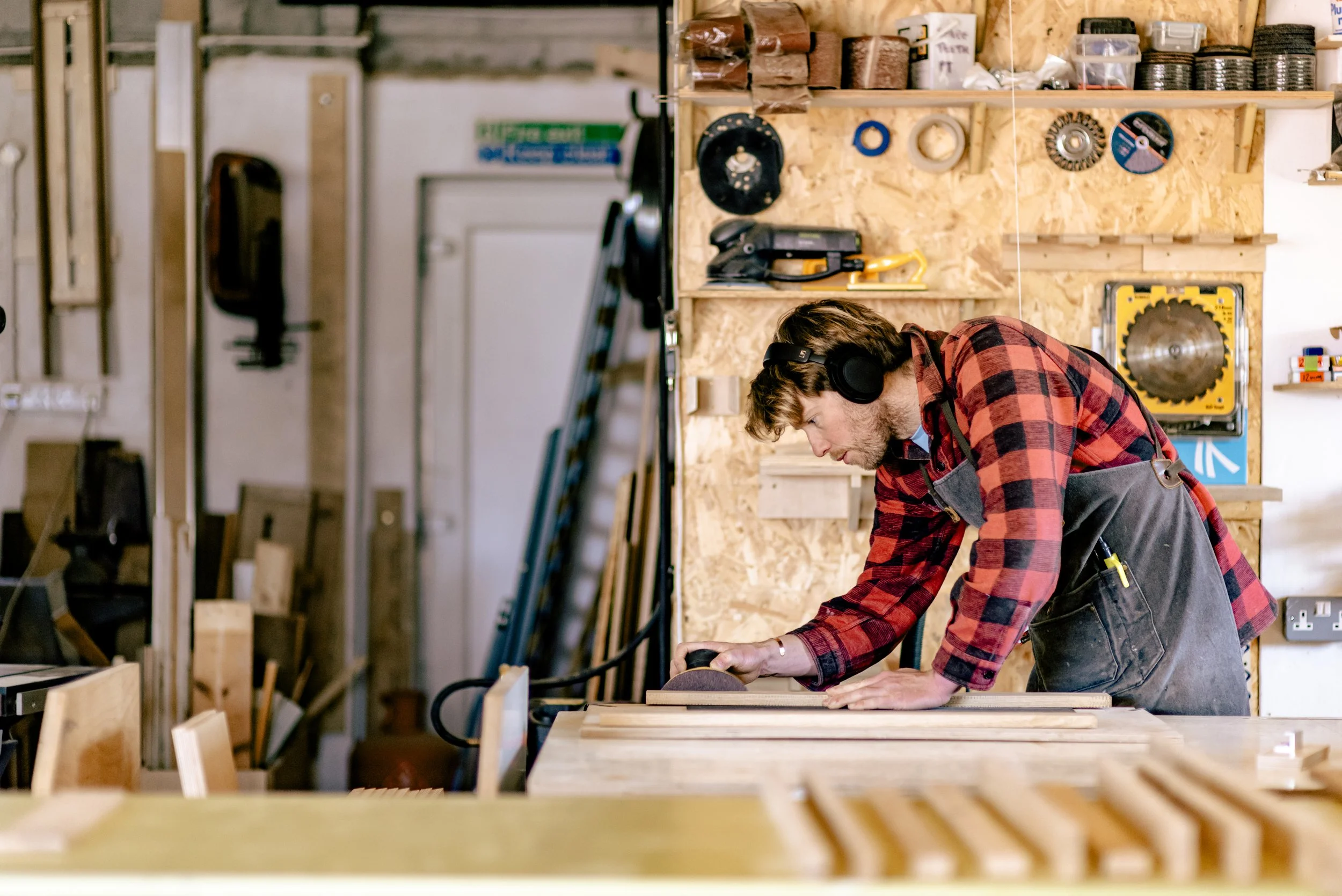
There is a romantic image often attached to craft.
A solitary maker in a workshop.
Hand tools. Quiet concentration. Singular objects emerging slowly through patience and skill.
And while there is truth inside that image, it only tells part of the story.
Because eventually, if a studio wants to survive commercially, another question arrives:
What happens when people actually want more of the thing you make?
That question sits at the centre of where Stratum Marquetry finds itself today.
We are no longer simply experimenting with materials in isolation. We are trying to build systems capable of producing repeatable patterned surfaces from reclaimed and recycled materials at a meaningful scale — while preserving the originality and richness that made the work interesting in the first place.
That is an incredibly difficult balancing act.
Small, But Thinking Big
One phrase we often return to is this:
We are small, but we think big.
The term multinational is not an axis we think about, design our work, or plan our growth around. Our choice to repurpose waste will create organic approaches to thinking and operating our business.
Our materials are inherently finite and variable. We rely on offcuts, reclaimed stock, industrial leftovers and recycled material streams. Those resources are shaped by local economies, by manufacturing waste, by what is available and by what would otherwise be discarded.
That means our growth will always be guided by balancing our understanding of material categories, their availability and our ability to process them.
This balancing act is valuable.
The goal is not infinite expansion.
The goal is intelligent scale.
The Difference Between Art And Production
One of the biggest lessons we have learned is that making artworks and manufacturing products are fundamentally different activities.
Artwork can absorb enormous amounts of complexity and unpredictability. A singular piece can justify highly labour-intensive processes because its value often sits inside uniqueness itself.
Products behave differently.
If a surface is going to become flooring, wall panelling, furniture or architectural detailing, then the process needs repeatability. Materials need consistency. Timelines need structure. Costs need to be predictable.
That changes how you think about making.
The challenge is no longer simply “Can we make this?”
It becomes “Can we make this reliably, repeatedly and sustainably?”
That shift requires a very different mindset.
Processes that once depended entirely on intuition now need to become documented systems. Materials need categorising. Costs need recording. Recipes need defining. Machinery needs refining.
The studio gradually evolves from artistic experimentation into something closer to process engineering.
Not less creative — just differently creative.
Turning Pattern Into Process
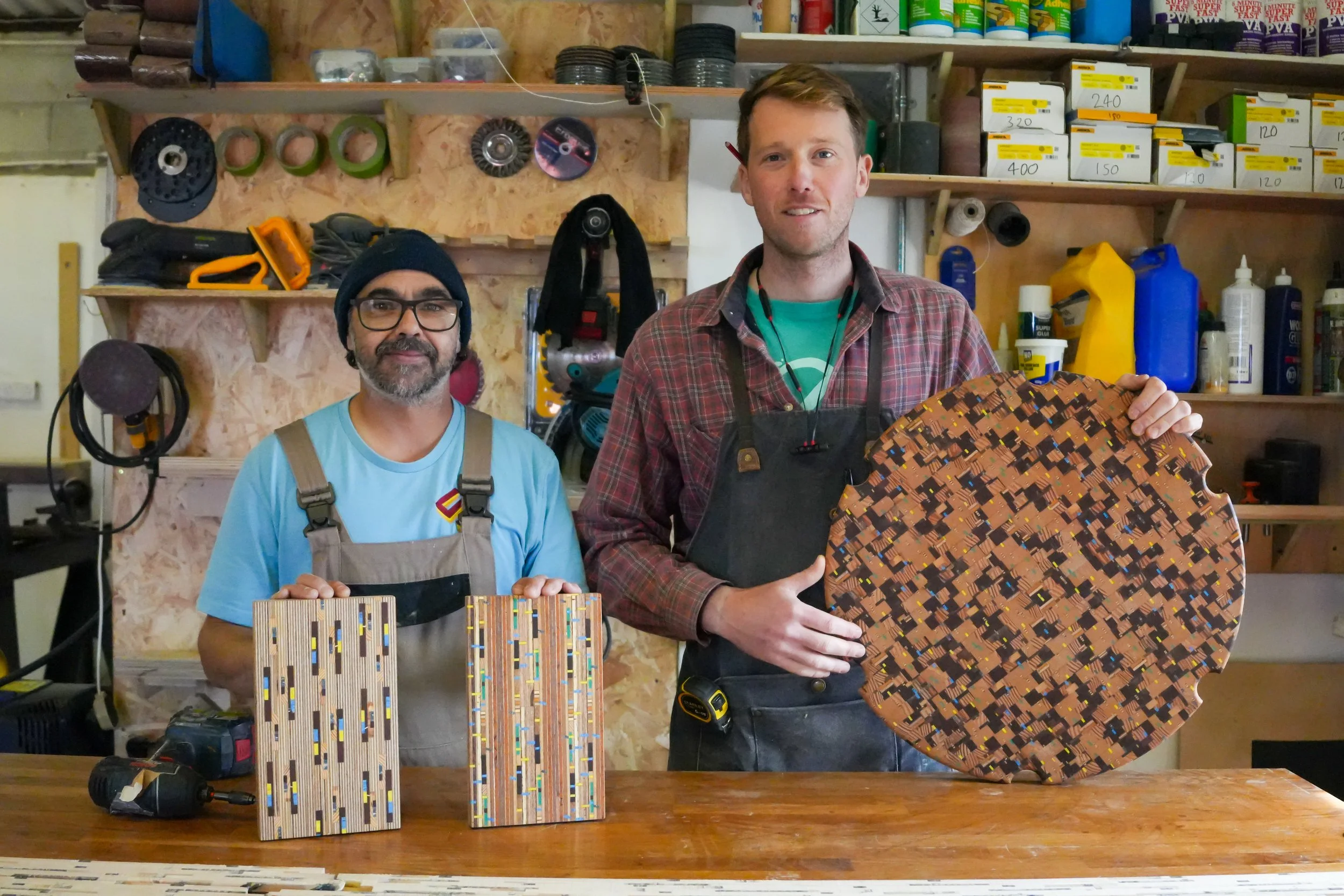
At the heart of Modern Marquetry is the marquetry block itself — the composite structure from which patterned surfaces emerge.
Early on, much of this process was highly manual and instinctive. One person moving between machines, cutting, bonding, surfacing, re-cutting and improvising continuously.
That approach works beautifully for exploration.
It does not work particularly well for scale.
As demand increases, the process has to become more structured.
The future workshop we imagine looks very different from the early garage experiments.
Materials arrive from waste-stream partners and are categorised, stored and processed according to type, dimension and potential application. Teams prepare component materials — laminating strips, processing substrates and organising repeatable material systems.
Machinists operate CNC routers using digital files specific to each marquetry pattern. Components move through repeatable stages: cutting, filling, bonding, surfacing, re-cutting and finishing.
Instead of one person improvising constantly, the process becomes collaborative.
The marquetry itself evolves into something closer to a recipe.
And importantly, that recipe can then be taught.
Why Editing Matters
One of the most important realisations behind this transition has been the value of editing.
In the early years, the temptation was always toward greater complexity. More materials. More variation. More experimentation. More possibilities.
But complexity creates friction.
The more variables involved in a process, the harder it becomes to repeat reliably. Costs become difficult to predict. Timelines become unstable. Conversations with clients become slower and more uncertain.
Over time, we realised that carefully defined parameters actually create freedom.
By refining material palettes, standardising dimensions and documenting processes, the studio can operate with far more confidence. Pricing becomes faster. Forecasting becomes possible. Production becomes clearer.
This has dramatically changed how conversations happen.
Previously, someone might ask how much a particular surface would cost and we would need days to calculate it. Now, because patterns and systems are increasingly formalised, many of those answers can happen almost immediately.
That clarity matters enormously.
Not only commercially, but psychologically.
It allows the business to move forward with intent rather than uncertainty.
The Human Side Of Manufacturing
One thing we are very conscious of is that scaling production should not come at the expense of people.
The future workshop we imagine is not an autonymnous factory detached from material and craft. It is still deeply human.
We imagine teams of people who understand the philosophy behind the work. People who care about materials, process and environmental responsibility. People learning specialist skills and contributing to a shared system of making.
Even as processes become more mechanised, there will always remain areas requiring judgement, sensitivity and understanding.
Machines can improve consistency.
They do not eliminate human value.
In fact, one of the ambitions behind scaling is precisely to create meaningful forms of skilled employment around sustainable material production.
The goal is not simply efficiency.
Rather, the vision is participation.
The Challenge Of Waste
Working with reclaimed and recycled materials introduces complexities that conventional manufacturing rarely encounters.
Large industrial manufacturers succeed partly because they operate using perfectly standardised materials available in enormous quantities. Waste-stream production works differently.
Availability fluctuates.
Material properties vary.
Supply chains remain irregular.
That means flexibility becomes essential.
Processes must be capable of adapting to inconsistency without losing overall coherence. Material systems need enough openness to absorb variation while still producing recognisable patterned outcomes.
In some ways, this becomes a new model of manufacturing altogether.
Not hyper-standardised industrial production.
Not purely one-off artisanal craft.
Something positioned between the two.
A hybrid form of contemporary making shaped by material recovery, digital production and small-scale systems thinking.
Beyond Objects
Increasingly, we also see the studio less as a producer of singular objects and more as a developer of material systems.
The marquetry itself becomes an ingredient capable of existing across multiple applications:
Furniture.
Wall panels.
Flooring.
Architectural inserts.
Handles.
Interior detailing.
Collaborative sculptural work.
This shift is important because it allows the studio to focus on what it does best: developing distinctive patterned surfaces and composite materials.
Rather than trying to manufacture every possible end product internally, collaborations can emerge with architects, designers and manufacturers who apply those materials in different ways.
That creates a much more sustainable path for growth.
Building Toward The Future
The future of Stratum Marquetry is not fully defined yet.
And perhaps that is exactly how it should be.
What feels increasingly clear, however, is that the studio is moving toward a form of production that sits between craft, manufacturing and material research — a system where waste becomes resource, patterns become products and experimentation evolves into infrastructure.
The ambition is not simply to grow larger.
It is to build better systems.
Systems capable of producing beautiful surfaces responsibly.
Systems that create meaningful work.
Systems that rethink how materials move through production and consumption.
Most importantly, systems that prove small-scale manufacturing can still carry imagination, ethics and artistic ambition simultaneously.
Because perhaps the future of making is not about choosing between craft and industry.
Perhaps it is about learning how to combine the best parts of both.