Building Beauty From Waste | Sustainable Contemporary Design
There is a strange contradiction at the centre of contemporary manufacturing.
Modern society produces an extraordinary quantity of waste — mountains of discarded material generated through consumption, construction, packaging, fabrication and obsolescence — yet at the same time, industries continue extracting vast quantities of virgin resources to make new things.
For us, that contradiction became impossible to ignore.
At Stratum Marquetry, working with waste-stream and recycled materials did not begin as a marketing strategy or aesthetic trend. It emerged from a much simpler instinct:
There is already so much material in the world.
Why aren’t we using it?
Waste As Resource
From the beginning, we wanted to build a business that operated with a responsibility to the planet.
In its infancy, the idea opened conversations around sustainability, habitat regeneration and responsible business practices. But over time, the philosophy became increasingly material-specific. We realised that if our work centred around pattern and surface, then those surfaces could become a site for material recovery.
The obvious next question followed:
What happens if waste itself becomes the ingredient?
That shift fundamentally changed the studio.
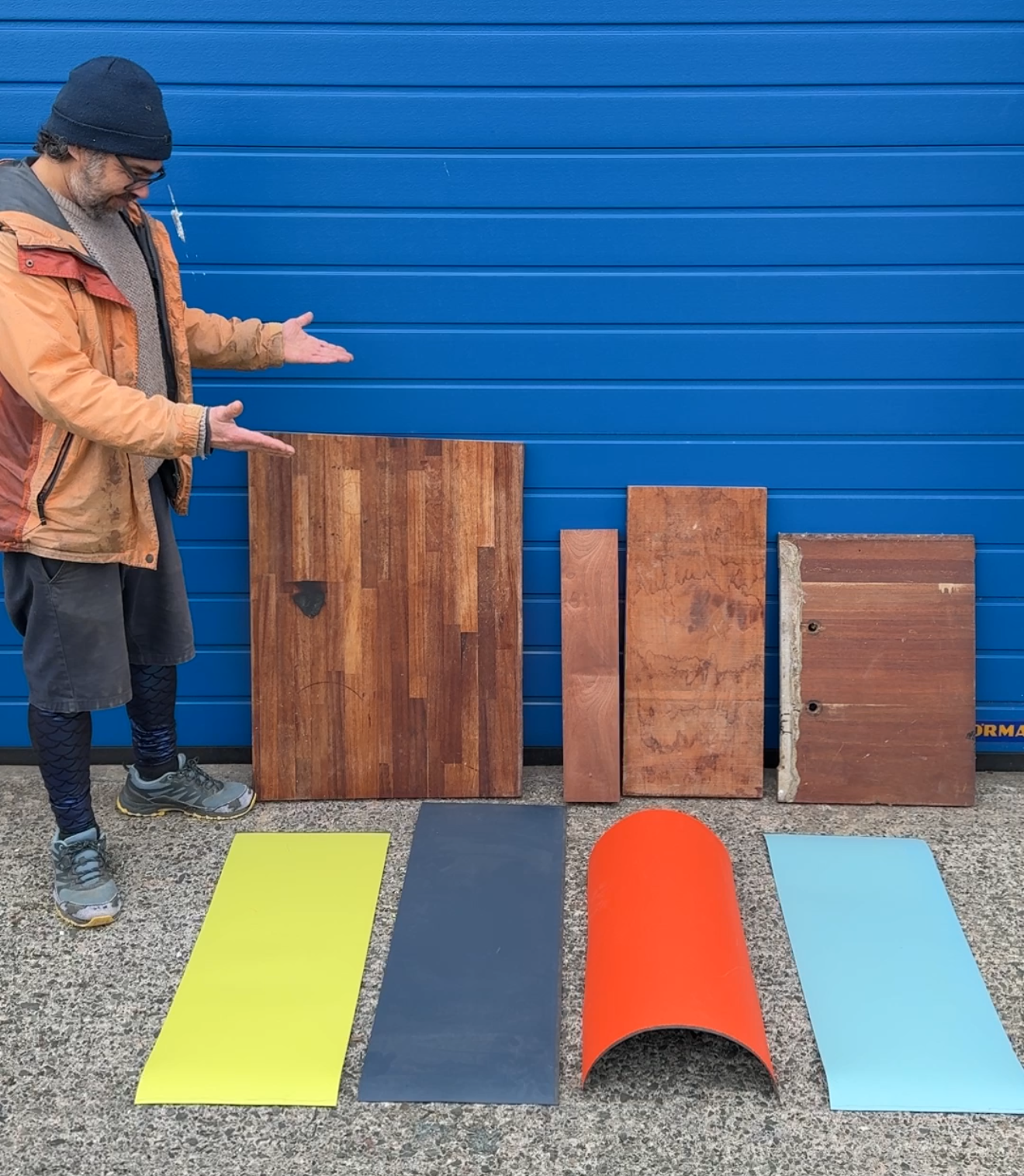
Instead of beginning with standardised materials selected from catalogues, we started looking at the overlooked edges of production systems — the remnants, offcuts and discarded materials that industrial processes leave behind.
Gradually, the spectrum of interesting materials broadened.
Joinery timbers, materials from domestic DIY projects, retail, educational and light industrial activities all became important categories for us to consider.
Materials that had lost their original value could be recombined into something entirely new.
Not disguised.
Not hidden.
Celebrated.
The Emotional Weight Of Waste
Waste carries emotional baggage.
Culturally, we are trained to think of discarded materials as lesser — contaminated by previous use, stripped of desirability, somehow incomplete. Virgin materials are often positioned as cleaner, more luxurious, more aspirational.
But we increasingly question that assumption.
Why should a material become meaningless simply because it has already existed within another system?
In many cases, reclaimed materials are more visually interesting than newly manufactured ones. They carry histories, inconsistencies, scars and irregularities that create richer surface language. They possess variation that industrial standardisation actively removes.
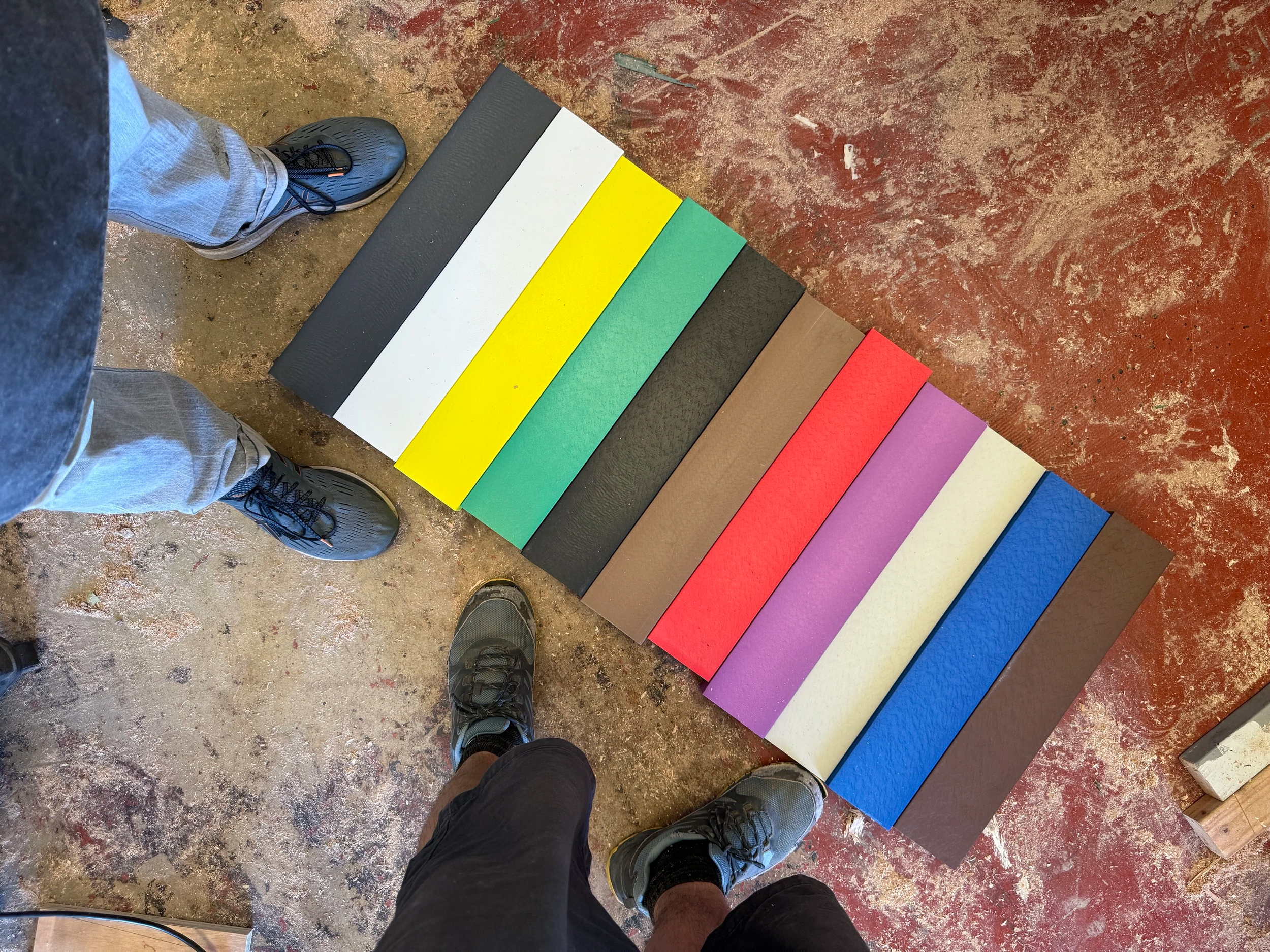
A reclaimed piece of timber might contain grain patterns impossible to reproduce commercially. A recycled plastic may carry accidental colour variation that feels more alive than something perfectly uniform.
The imperfections become part of the identity.
That perspective also changes the role of the maker.
Instead of imposing total control onto inert material, the process becomes collaborative. The material pushes back. It behaves unexpectedly. It forces adaptation.
Some materials resist bonding. Others machine poorly. Some reveal hidden textures only once cut open. Some create voids, inconsistencies or structural problems that require entirely new approaches to solving them.
In that sense, working with waste is not simply environmentally motivated — it is creatively generative.
The material itself contributes to the outcome.
Learning Through Failure
The reality of working with reclaimed and recycled materials is that failure becomes unavoidable.
Every new material introduces unknowns.
How does it behave under pressure?
Will it survive machining?
Does it bond effectively?
Can it withstand wear?
How does it age?
How does it interact with other materials inside a composite structure?
Many experiments simply do not work.
At one stage, we explored fully biodegradable marquetry blocks using animal-based glues instead of modern adhesives. The resulting pieces were visually exciting, but the glue reacted badly during machining, clogging blades and making production almost impossible.
Other materials proved difficult in different ways. HDPE plastics resist adhesion and require careful mechanical encapsulation within the structure of the block itself. CDs create pitted surfaces and voids. Softer recycled plastics behave unpredictably under finishing processes.
Failure is not an interruption to the process.
Failure is the process.
In fact, one of the earliest realisations behind the studio was that making itself is essentially a chain of problem solving. Every cut introduces a degree of error. Every solution generates another challenge. Eventually, you simply arrive at a point where the outcome feels resolved enough to stop.
The object is not perfection.
The object is resolution.
Over time, that understanding has evolved from artistic experimentation into something more structured. Early work often relied on improvisation and correction. Contemporary work increasingly depends on repeatable systems, carefully refined processes and production methods that reduce unnecessary unpredictability.
Not because unpredictability lacks beauty, but because products require consistency if they are to survive commercially.
Waste And The Question Of Value
One of the most interesting shifts happening culturally is the changing relationship between value and luxury.
Traditionally, luxury has often implied rarity, exclusivity and access to pristine materials. But increasingly, that definition feels outdated — perhaps even uncomfortable.
The world itself no longer feels luxurious.
Climate anxiety, overconsumption and environmental instability have forced new conversations around what constitutes meaningful value. In that context, working responsibly with materials may actually become more culturally significant than simply producing expensive objects.
We are increasingly interested in the idea that value can emerge through ethics, systems and responsibility — not simply exclusivity.
Using waste-stream materials does not automatically make something valuable. But thoughtful transformation does.
Care does.
Process does.
Attention does.
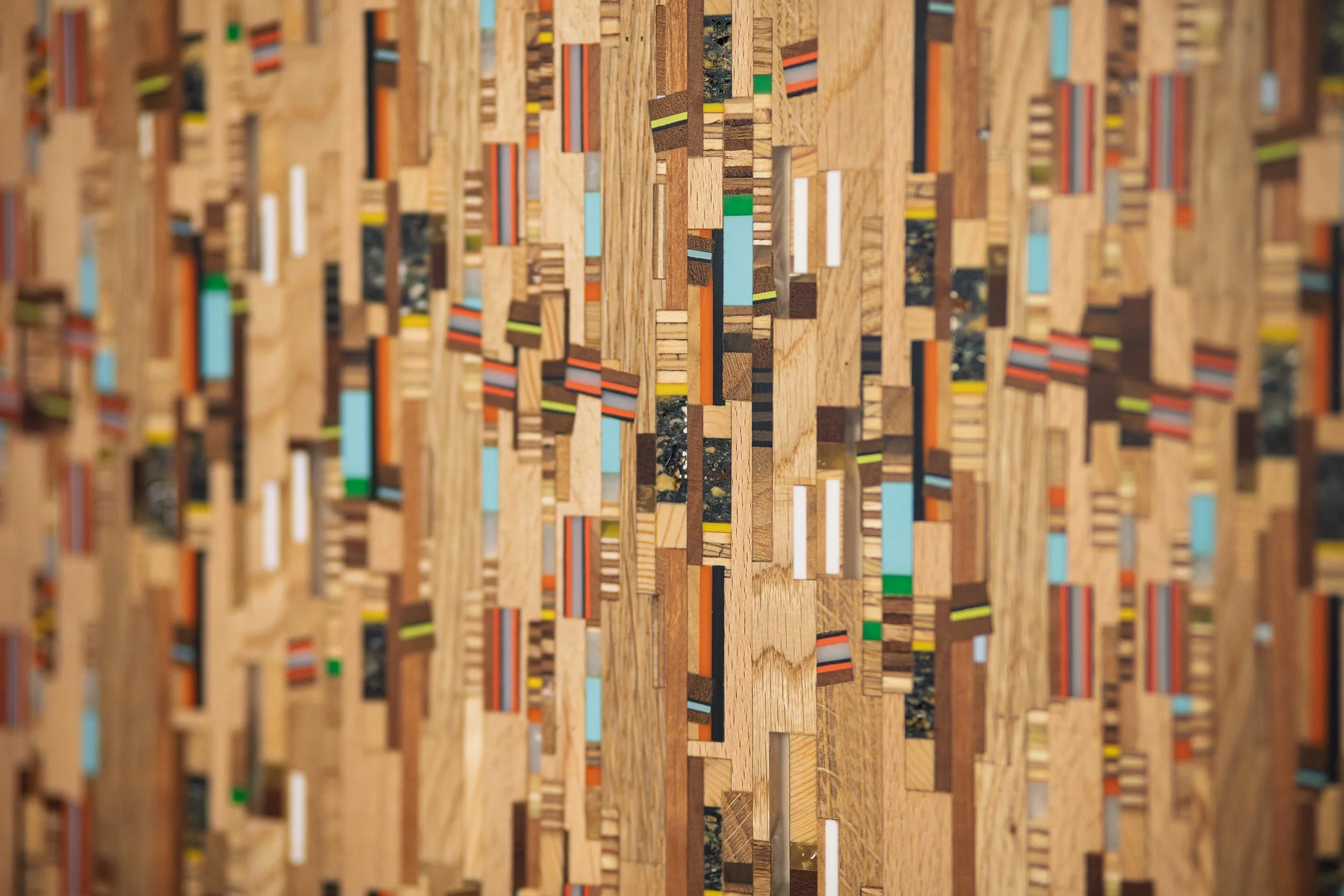
A surface built from reclaimed materials can still feel refined, contemporary and desirable. Sustainability does not need to look compromised or rustic. Recycled materials do not need to communicate sacrifice.
They can communicate ambition.
Beyond The Studio
As Stratum Marquetry evolves, the ambition is not simply to make more objects.
The ambition is to formalise relationships around material recovery itself.
That means building long-term partnerships with workshops, manufacturers and waste-stream suppliers. It means understanding how materials flow through local economies. It means designing production systems that can accommodate inconsistency while still producing reliable outcomes.
Importantly, it also means recognising limits.
Because we rely on waste streams, our growth will always remain tied to the availability of reclaimed material. We are not aiming to manufacture endless quantities of identical products — we are comfortable with this.
The limitation is part of the philosophy.
Instead, the future looks more like a carefully scaled network: small teams, specialist processes, localised material partnerships and highly considered production systems capable of transforming discarded resources into long-lasting surfaces.
The goal is not perfection.
The goal is participation.
To demonstrate — even at a small scale — that another way of making is possible.
That waste can hold beauty.
That discarded materials can carry value.
And that contemporary design does not need to depend entirely on extracting something new from the planet every time we want to create something meaningful.