Tell me again… What Is Modern Marquetry?
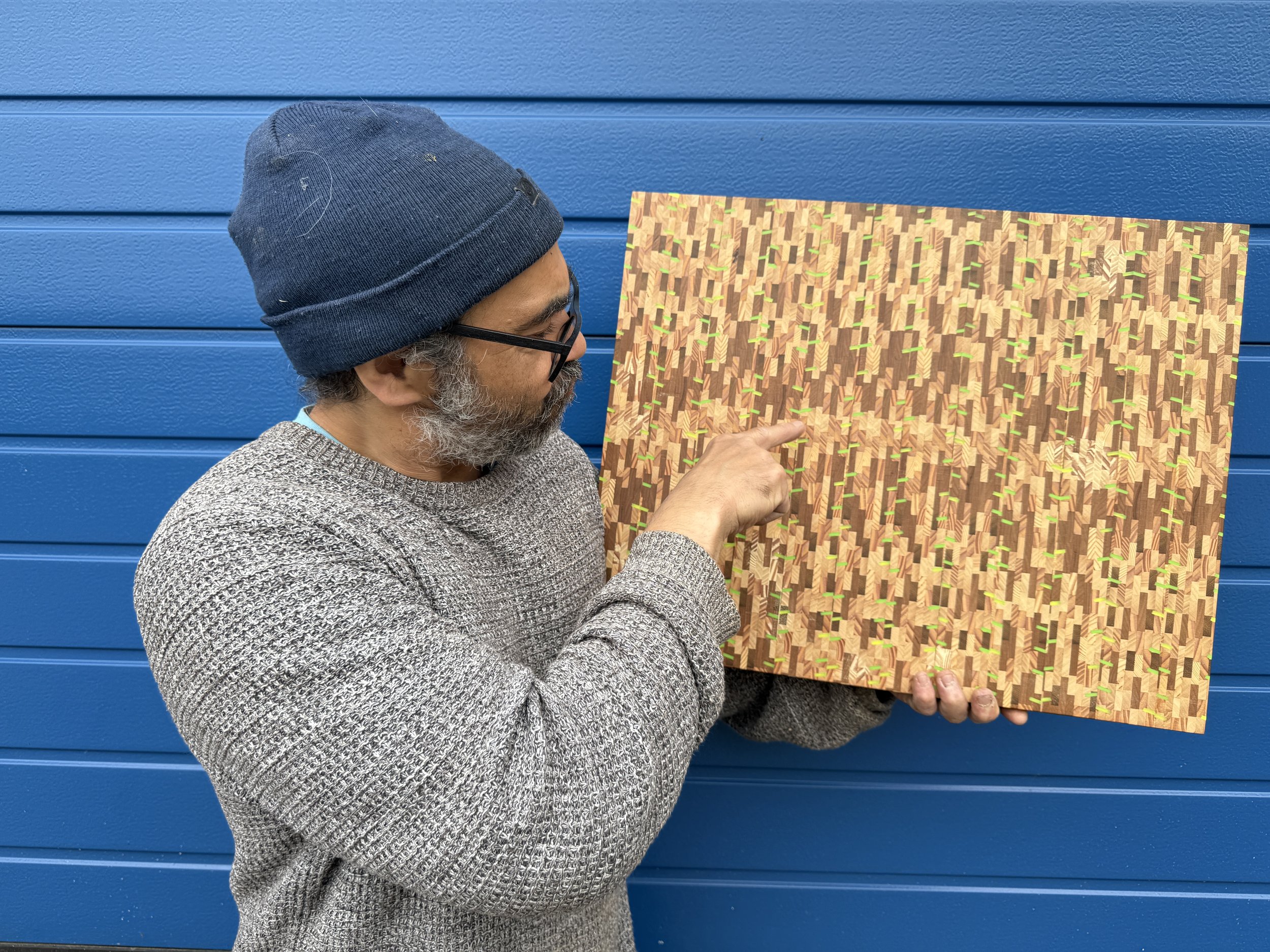
There is a moment in almost every conversation about Stratum Marquetry where someone pauses, looks closely at the surface in front of them, and asks the same question:
“So… how is this actually made?”
Most people assume they already know the answer. They see geometric forms, repeated lines, colour combinations and material contrasts, and naturally connect the work to traditional marquetry — the centuries-old decorative craft associated with fine furniture and carefully inlaid veneers.
But what we make is not traditional marquetry.
Not really.
The term Modern Marquetry emerged because we needed language for something that sat somewhere between material experimentation, surface design, manufacturing, sculpture and craft. We were not simply making furniture, and we were not reproducing historical processes either. We were developing a way of constructing patterned surfaces using contemporary materials, industrial waste streams and layered composite structures.
In many ways, the term arrived after the work itself.
A Departure From Tradition
Traditional marquetry is generally understood as the careful cutting and placement of thin veneers into matching voids to create decorative imagery or pattern. It is meticulous, highly skilled, and deeply tied to historic furniture making traditions.
Our process evolved from a very different place.
Rather than working primarily with veneer, we work with materials that already exist in the world around us — reclaimed timber offcuts, recycled plastics, discarded flooring, HDPE, acrylics, lino, engineered boards, resin composites, shells, CDs and industrial waste materials that would otherwise be overlooked or thrown away.
These materials undergo a repeated machining and assembly process, producing patterned surfaces that are structural rather than superficial. The pattern is not applied afterwards. The pattern exists through the material.
That distinction matters.
The result is something that still belongs to the lineage of marquetry because it deals with surface, composition, geometry and embedded material contrast — but it behaves differently. It is thicker, more architectural, more composite, more industrial and often more unpredictable.
That unpredictability is important.
Pattern As The Artefact
When Stratum first began — originally under the name Stratum Designs — we thought we were making furniture. Tables. Interior products. Bespoke wooden objects.
But over time, something became obvious.
People were not primarily responding to the object itself. They were responding to the patterned material language embedded within it.
The pattern was the thing.
The furniture became almost secondary — a vehicle through which the surface could exist.
That realisation fundamentally changed the direction of the studio.
If we were chefs, pattern would be our signature dish.
Everything since then has been about refining the process that produces those patterns, understanding how to repeat them, and learning how to scale them without losing the excitement that made them compelling in the first place.
That shift became particularly clear around the Surface Design Show in 2024, where conversations repeatedly circled back to the surfaces themselves rather than the products they inhabited. Architects, designers and makers were not asking us how we built furniture — they were asking us about materials, textures, repeatability and application.
That was the turning point.
Why Waste Matters
From the very beginning, we wanted to build a business that was as kind to the planet as possible.
At first, that idea existed in broad terms — conversations around sustainability, habitat regeneration and ethical business structures. But eventually the logic became unavoidable:
If contemporary life produces enormous quantities of waste material, why wouldn’t we attempt to build beauty from it?
Waste is everywhere.
Short lengths of timber too small for joinery workshops. Plastic offcuts. Discarded flooring. Acrylic remnants. Beach-clean plastics. Materials that industrial systems no longer value despite the fact they still possess structural, visual and aesthetic potential.
We became interested in reframing waste not as failure, but as resource.
That doesn’t mean every material is easy to use. Some are difficult, inconsistent and frustrating. HDPE plastics resist bonding. CDs produce voids and interruptions in the surface. Certain biodegradable glues fail under machining processes. Softer recycled plastics behave differently to hardwoods. Some materials simply refuse to cooperate.
But those challenges are part of the process.
The material itself becomes an active participant in the design conversation.
Sometimes it pushes back.
Between Art And Product
One of the biggest tensions within the studio is the relationship between artistic freedom and repeatable production.
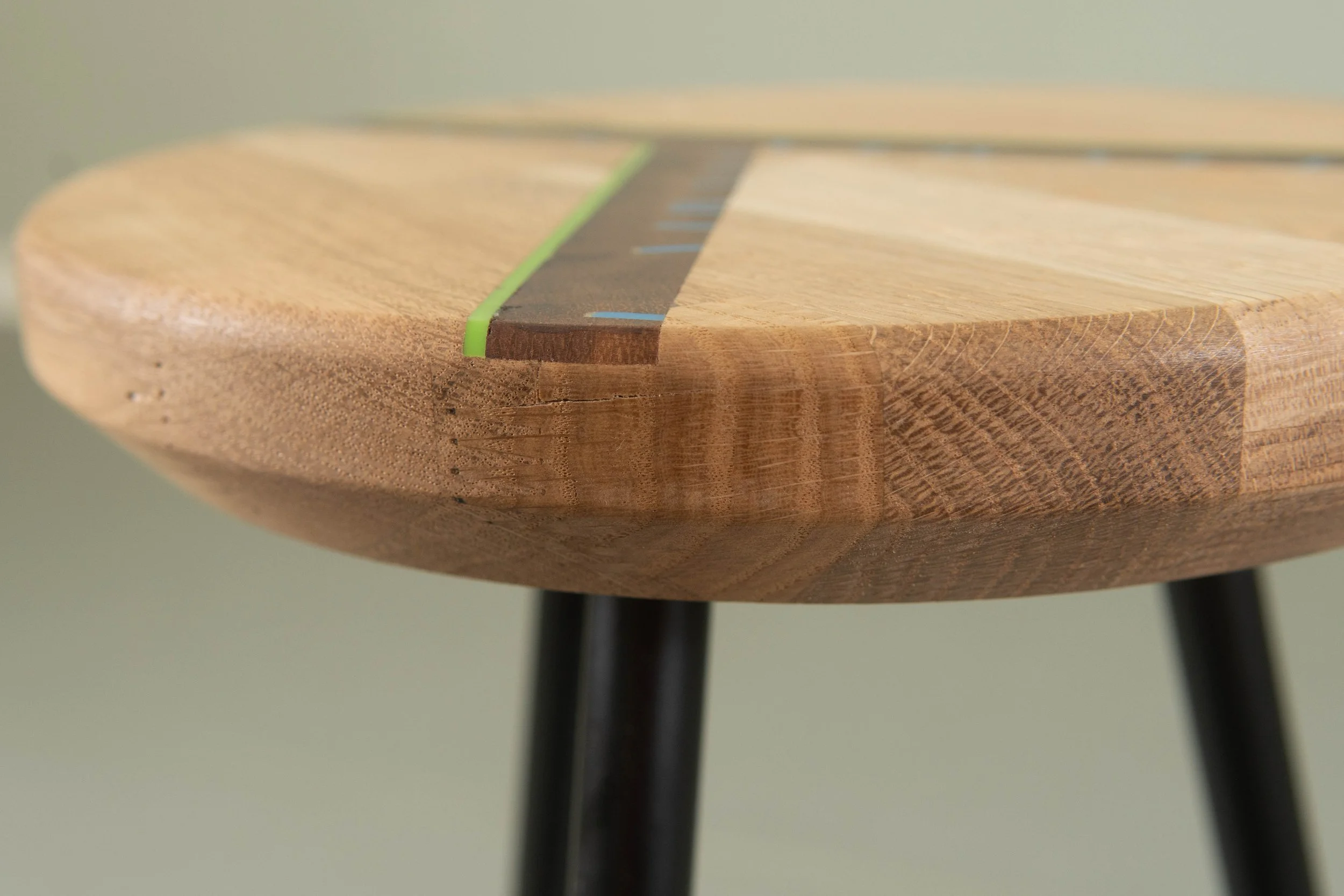
Artwork allows for complexity without restraint. More materials. More machining. More unpredictability. More experimentation. The Future Icons pieces, for example, combined an enormous range of waste materials into dense, layered compositions that could never realistically become mass-repeatable products.
And that freedom is exciting.
But products operate differently.
A product has to be repeatable. It has to fit within a financial structure. It has to be manufacturable, describable and consistent enough that someone can order it again.
That requirement changes the process.
Over time, we’ve moved away from endlessly correcting errors by hand and towards developing more controlled systems of production. Not because we value artistry less, but because we understand that if these materials and ideas are going to survive commercially, they need frameworks.
The challenge is maintaining excitement while reducing chaos.
That tension sits at the heart of Modern Marquetry.
A Material Language Still Emerging
We still think of Stratum Marquetry as something in development.
The process is evolving. The language is evolving. The systems are evolving.
What excites us most is the possibility that these patterned surfaces might eventually exist across multiple scales and applications — from artworks and collectible objects through to interiors, furniture, architectural components and collaborative manufacturing projects.
Not through industrial perfection, but through thoughtful repetition.
We are not trying to become a multinational manufacturing company.
The reality of working with waste-stream materials means our growth will always remain connected to the availability of reclaimed resources and the relationships we build with suppliers, fabricators and waste partners.
That limitation is not a weakness.
In many ways, it is the philosophy itself.
Modern Marquetry is not simply about creating decorative surfaces. It is about reconsidering how materials move through the world, how waste can acquire value again, and how pattern can become a bridge between sustainability, manufacturing, art and design.
Ultimately, we are trying to prove that recycled materials do not need to look compromised.
They can look ambitious.
They can look contemporary.
They can look beautiful.