Who Is Modern Marquetry For?
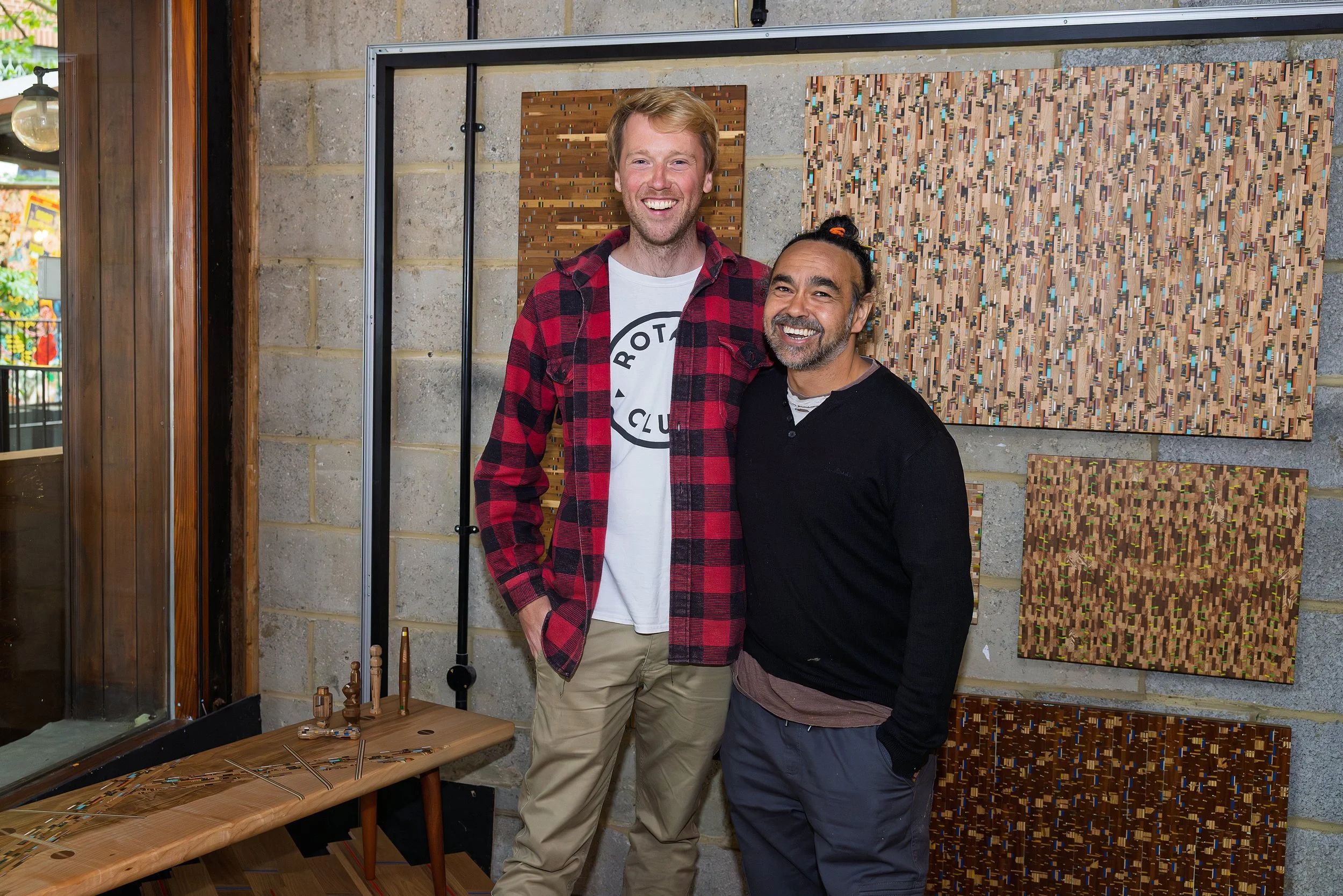
One of the most difficult things for any creative practice to understand is not simply what it makes, but who it is making it for.
At the beginning of Stratum Marquetry — then operating under the name Stratum Designs — we did not have a particularly clear answer to that question.
We knew the work felt exciting.
We knew the material process felt unusual.
We knew the patterns had a distinctive visual language.
But beyond that, everything was still unfolding.
The business existed more as a direction of curiosity than a fully formed commercial structure. We were exploring what the process could become, what kinds of objects it could inhabit, and how people might respond to it.
Over time, however, one thing became increasingly clear:
Understanding your audience changes the work itself.
The Early Assumption
Initially, we positioned ourselves broadly as bespoke makers.
Furniture makers.
Interior specialists.
Patterned surface makers.
The assumption behind that model was relatively straightforward: private clients with enough disposable income would commission highly bespoke pieces, make strong aesthetic decisions and allow us to realise those ideas physically.
And to some extent, that did happen.
But there was an underlying problem hidden inside that assumption.
Most people are not trained to make bold aesthetic decisions.
In fact, most people actively avoid them.
Choosing highly distinctive surfaces, materials and patterns — particularly expensive ones — requires confidence. It requires visual imagination. It requires the ability to understand how something unusual might exist inside a completed space.
That is actually a very specialised skill.
At first, we assumed more people possessed it than they really do.
Discovering The Real Audience
As the studio evolved, we began to realise something important about how creative industries actually function.
Most private individuals do not directly design ambitious interiors themselves.
Instead, they employ people who do.
Interior designers.
Architects.
Creative consultants.
Specifiers.
Design-led businesses.
These are the people professionally trained to make aesthetic decisions. They are the people capable of imagining unusual material applications, combining references, understanding spatial relationships and taking creative risks on behalf of clients.
In many ways, they act as translators between experimentation and practical implementation.
That understanding significantly shifted how we began presenting the studio.
Rather than speaking only to individual consumers, we increasingly started speaking to the people responsible for shaping environments professionally.
The work itself did not fundamentally change.
The audience did.
And that changed everything.
Aesthetic Bravery
One phrase we often return to internally is aesthetic bravery.
Modern Marquetry is not neutral.
The surfaces attract attention. The materials carry a strong visual identity. The work asks people to make choices — sometimes bold ones — about colour, texture, pattern and material expression.
Not everyone wants that.
Some people want invisibility from design. Others want calm familiarity. But there is another group — individuals and studios actively searching for surfaces with character, story and material depth.
Those are the people we increasingly recognise as our audience.
Aesthetically brave people.
That does not necessarily mean extreme or flamboyant design. It simply means a willingness to engage emotionally with material and to move beyond purely functional specification.
Interior designers often operate comfortably within that territory because experimentation is already part of their professional language.
For us, that has become incredibly important.
We no longer expect every person to instinctively understand the work. Instead, we focus on connecting with the people already searching for this kind of material expression.

The Difference Between Art And Product Audiences
Understanding audience also clarified another major distinction within the studio:
Artworks and products attract very different people.
The one-off artworks often appeal to collectors, galleries, design fairs and individuals interested in rarity, experimentation and conceptual material practice. These audiences are comfortable with singularity and abstraction. The value sits heavily in uniqueness.
Products operate differently.
Wall panels, flooring systems, furniture surfaces and architectural applications need to fit within larger commercial and spatial frameworks. Here, the audience becomes more pragmatic.
Questions shift toward:
Can this be repeated?
Can it be specified reliably?
Can it survive commercial environments?
What are the lead times?
What is the pricing structure?
How scalable is the process?
That distinction has become essential to understanding how the business communicates.
Trying to sell artwork in a flooring showroom makes little sense.
Trying to sell flooring through fine art language creates confusion.
Each category requires its own context, language and audience.
The Importance Of Clarity
One of the biggest developments within the business has been learning how to articulate clearly what the studio actually does.
In the early years, conversations often became sprawling and abstract. The work touched so many different disciplines — craft, sustainability, material innovation, design, furniture, interiors — that it became difficult to describe concisely.
Over time, however, we realised that clarity creates opportunity.
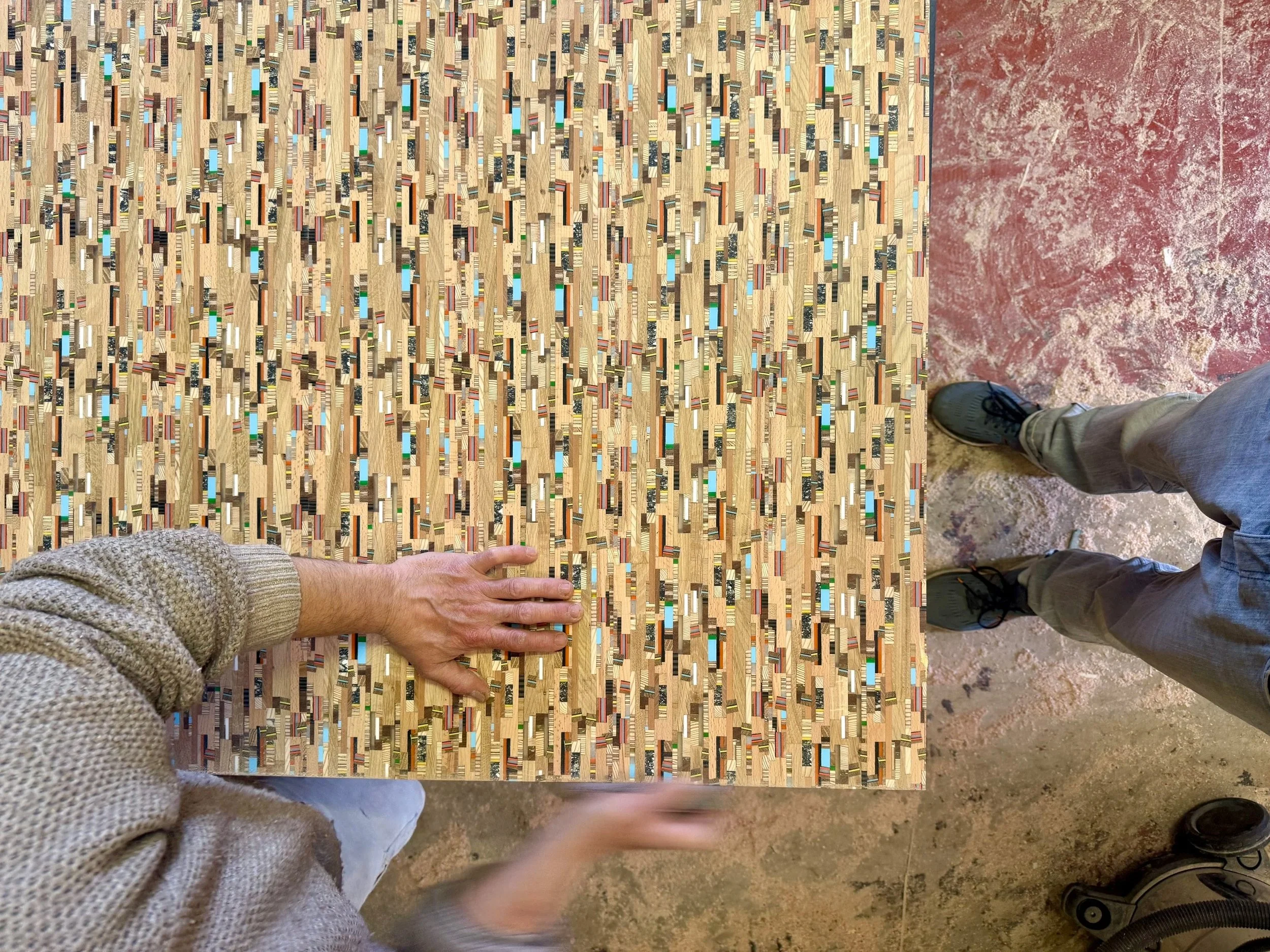
Today, the studio increasingly positions itself around patterned surfaces and Modern Marquetry as a material language. That language can then be applied across multiple product categories: wall panels, flooring, furniture, architectural inserts and collaborative design applications.
That framing helps people understand the work much faster.
Importantly, it also helps people imagine how the work might fit into their own projects.
The Business-To-Business Shift
As our understanding of the audience matured, another direction emerged naturally: business-to-business collaboration.
Increasingly, we became interested not only in finished objects, but in supplying patterned material systems that other companies could integrate into their own products.
This opens exciting possibilities.
Kitchen manufacturers incorporate patterned recessed handles.
Furniture brands embedding marquetry inserts into cabinetry.
Architectural studios specifying bespoke surface systems.
Lighting designers machining sculptural forms from composite blocks.
In this model, the marquetry itself becomes an ingredient rather than a finished object.
That shift feels important because it allows the studio to focus on its strengths: developing distinctive patterned material systems rather than trying to manufacture every possible end-use product internally.
The work becomes more collaborative, more scalable and potentially more adaptable across industries.
Understanding Value Alignment
Perhaps most importantly, identifying the right audience is not simply about sales.
It is about alignment.
The people most drawn to the work tend to share certain underlying values:
Curiosity about materials.
Interest in sustainability.
Appreciation for the process.
Respect for craft and experimentation.
Willingness to engage with contemporary design language.
That alignment matters enormously because Modern Marquetry is not purely decorative. The work carries embedded ideas around waste, production, material recovery and responsible making.
The surfaces are not neutral objects detached from those conversations.
They are physical manifestations of them.
Still Evolving
The truth is that the audience for Modern Marquetry is still evolving — just as the studio itself continues evolving.
That uncertainty is not necessarily a weakness.
In many ways, it reflects the fact that the work occupies an unusual space between art, design, manufacturing and sustainability. The audience emerges gradually as the language becomes more defined.
What feels clearer now is this:
We are not trying to make surfaces for everyone.
We are making surfaces for people willing to engage with material differently — people interested not only in how something looks, but also in how it was made, what it was made from and what kinds of values it carries into the world.
Those people already exist.
The challenge is simply continuing to find them.