Failure, Process and Learning How to Make
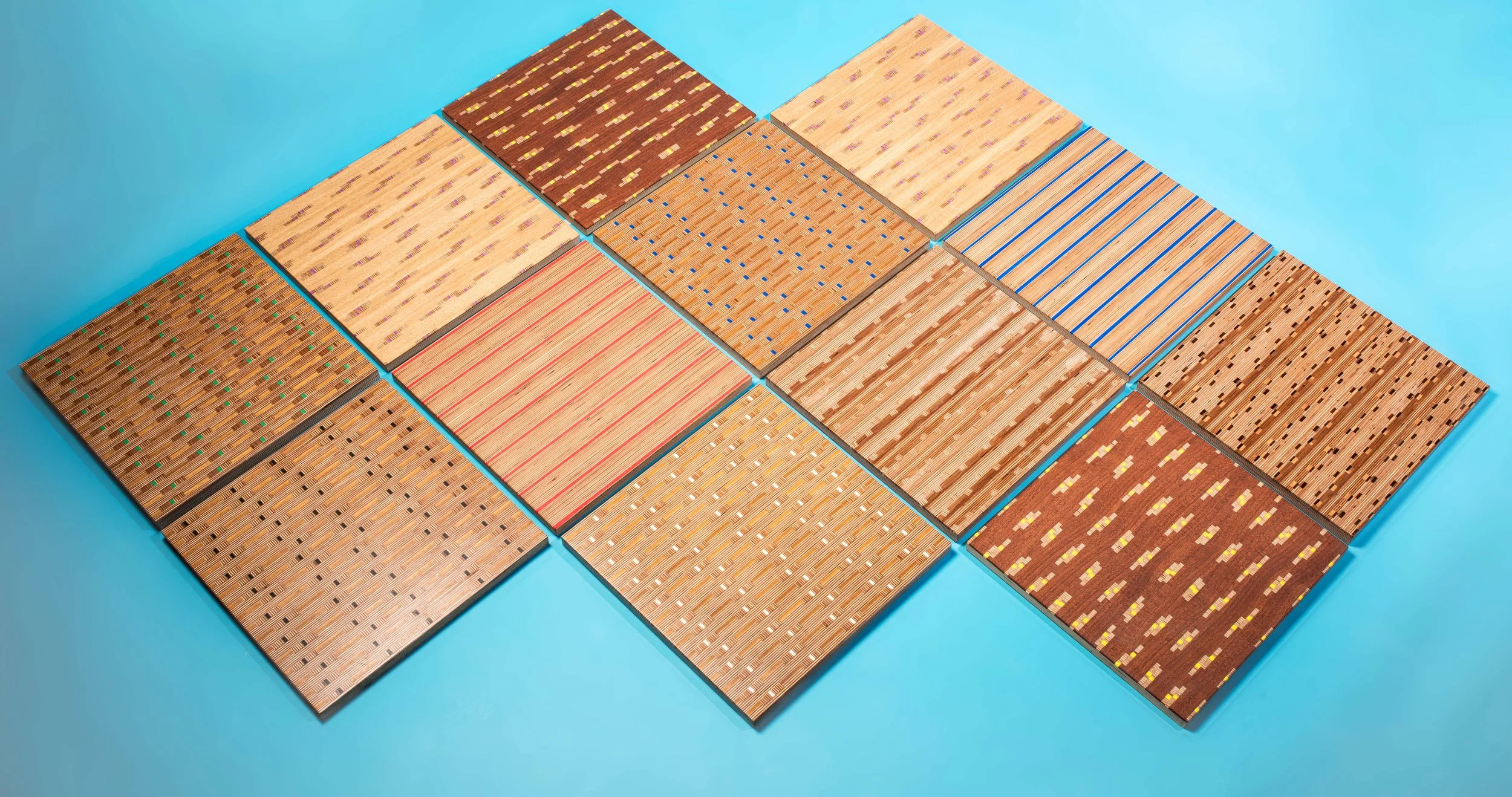
There is a tendency within design culture to present finished objects as though they emerged fully resolved.
Clean photographs. Controlled lighting. Perfect surfaces. Confident language.
The reality of making is usually much messier than that.
Behind almost every finished piece sits a narrative of challenges, experiments, compromised materials, broken tooling, incorrect assumptions, process redesigns and moments where things just didn't quite work well enough.
For us this narrative is not an unfortunate side effect of the process.
It is is the process.
In fact, many of the most important developments within the studio have emerged directly from overcoming a challenge.
The Early Realisation
Before Stratum existed as a business, the work began much more simply — experimenting with materials alone in a garage, trying to understand how patterns might emerge through cutting, layering and recombining surfaces.
One of the earliest realisations was strangely philosophical:
Every process generates errors.
You cut something and there is a slight inaccuracy. Then you solve that inaccuracy, but the solution itself creates another problem. You solve that problem, which generates another one. And so the process continues.
Making became less about perfection and more about managing chains of consequence.
At some point, you simply decide that the object has reached a level of resolution you are comfortable with. The process stops not because the errors disappear entirely, but because the outcome becomes desirable enough to hold together.
That understanding shaped a huge amount of the early work.
Many surfaces were highly improvised, heavily corrected and deeply instinctive. Imperfections were not removed entirely — they were absorbed into the visual language of the work itself.
In some cases, those “mistakes” became defining characteristics.
From Improvisation To System
As the studio evolved, however, it became increasingly clear that artistic improvisation alone could not sustain a repeatable product range.
A one-off artwork can absorb unpredictability. A commercial product cannot.
If a customer commissions a surface, a flooring system or a wall panel, they expect consistency. They expect the thing they ordered to resemble the thing they were shown. That requires process control.
Over time, this forced a major shift in mindset.
The work moved away from endless correction and towards more considered systems of production. The challenge became reducing unnecessary unpredictability while preserving enough variation and excitement to keep the surfaces alive.
That transition has been one of the biggest learning curves within the business.
Not because the artistry disappeared, but because artistry increasingly had to coexist with repeatability, pricing structures, timelines and manufacturability.
The process itself became something to design.
The Thicknesser Incident
Some lessons arrive very clearly.
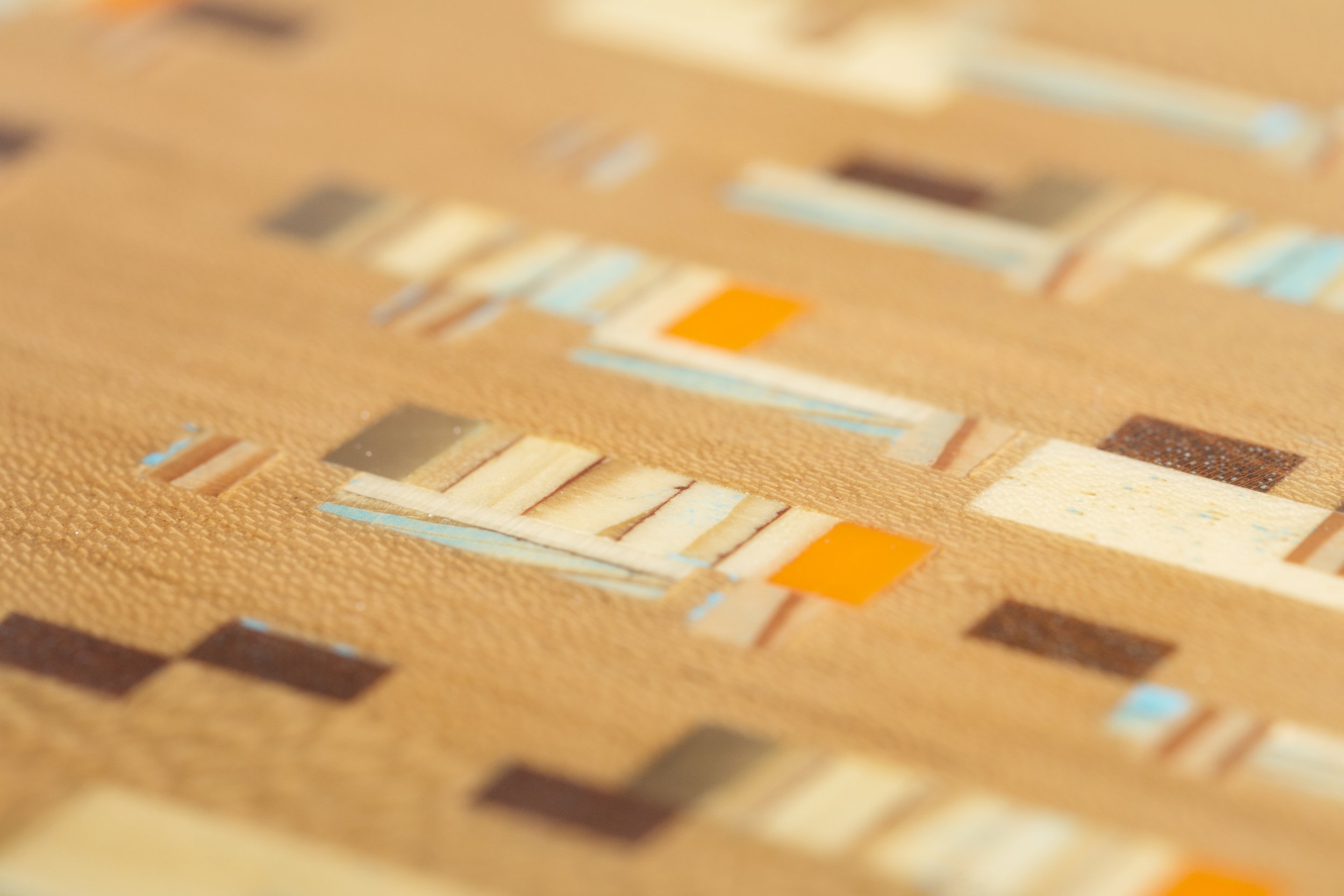
At one stage, we were producing sample wall panels with highly detailed marquetry surfaces bonded onto birch ply substrates. The final stage involved flattening the surface after assembly.
At the time, we were using a planer thicknesser for this process.
In principle, it worked.
In practice, it was terrifying.
A marquetry panel represents many hours of labour, material preparation and machining. Sending that object through a high-powered machine capable of tearing chunks out of the surface is a strangely stressful experience.
And eventually, exactly that happened.
One panel entered the thicknesser slightly unevenly. The cutter block caught the surface and tore a large divot directly through the marquetry layer — instantly destroying hours of work.
Technically, the piece was salvageable because it only needed to function for photography rather than as part of a repeat production set. The panel could be machined thinner and recovered.
But the lesson was much bigger than the damaged surface itself.
The realisation was that the process had become too risky.
Too dependent on nuance.
Too dependent on instinct.
Too dependent on operator judgement.
If the ambition is eventually to scale production and involve wider teams, then processes cannot rely entirely on highly intuitive decision-making. They need to become safer, clearer and more systematic.
That failure directly informed future manufacturing thinking.
Certain processes now need to transition toward more stable, controllable systems — such as drum sanding rather than aggressive planing operations. Not because the old methods were creatively invalid, but because scalable production requires consistency.
Sometimes failure simply reveals what the next version of the process needs to become.
Material Failure Is Information
Working with waste-stream materials introduces another layer of unpredictability.
Every material behaves differently.
HDPE plastics resist bonding.
Recycled acrylics machine differently to timber.
Certain glues clog blades.
Soft plastics deform under pressure.
CDs create pitted voids across surfaces.
Even materials that appear visually successful can reveal structural issues later in the process.
One experiment involved creating biodegradable marquetry blocks using animal-based glue rather than synthetic adhesives. Conceptually, the project aligned beautifully with the studio’s environmental ambitions. Practically, it became incredibly difficult to machine.
The glue behaved unpredictably under heat and friction, making the process almost unworkable.
But even unsuccessful experiments generate useful knowledge.
In many ways, the studio functions like an ongoing material research environment. Every failed glue-up, every damaged panel and every difficult machining process contributes to a growing understanding of how these unusual material combinations behave.
The failures become data.
The Importance Of Editing
Perhaps the most important lesson emerging from all of this has been the value of editing.
Early experimentation often operated without strong limits. Materials were combined freely. Processes expanded endlessly. Complexity itself became seductive.
Over time, however, we realised that constraints are not creative obstacles. They are creative tools.
Editing creates clarity.
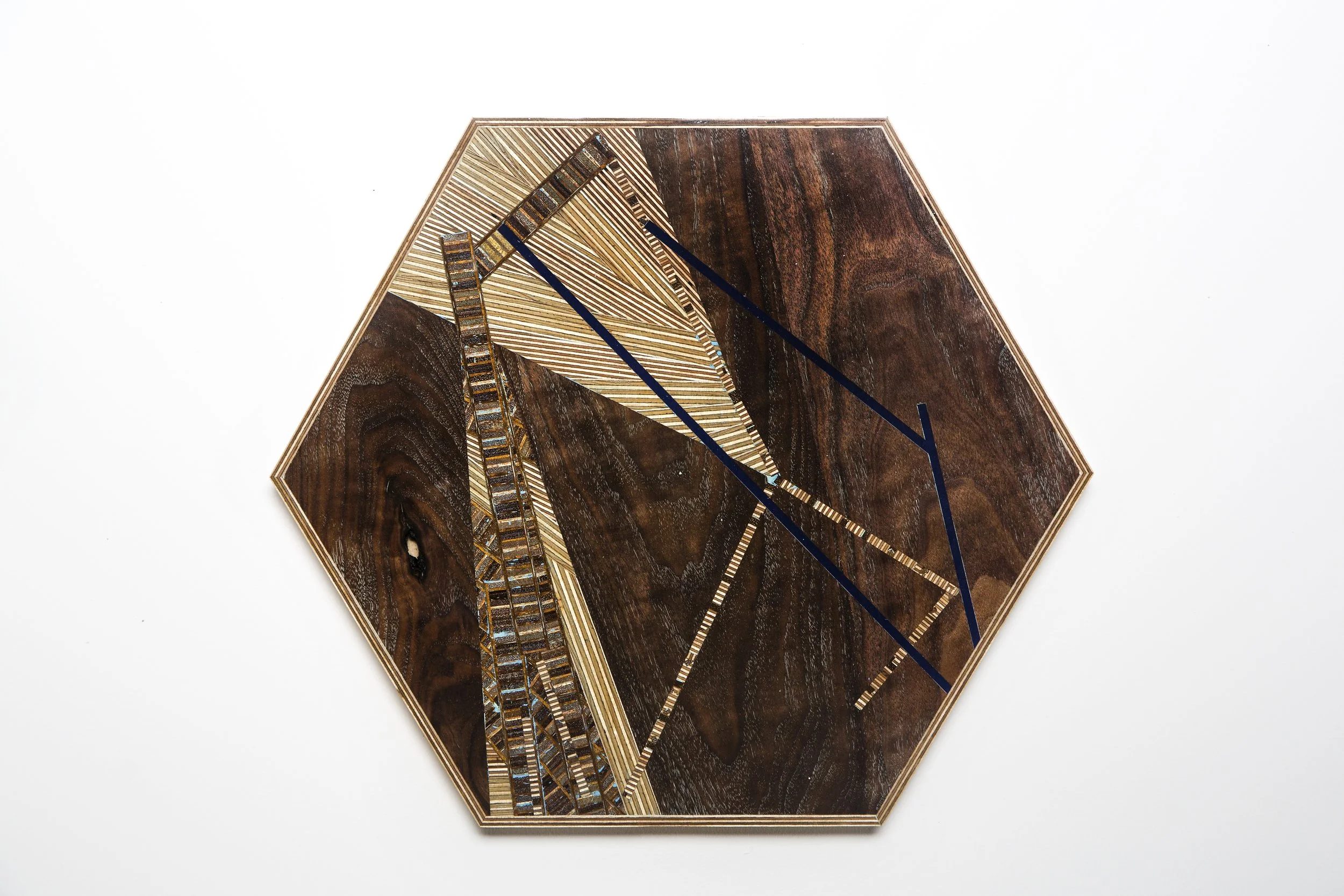
By limiting palettes, refining processes and defining parameters, it becomes possible to build systems that are financially viable, repeatable and scalable — while still retaining visual excitement.
This has become increasingly important commercially.
Today, because patterns, materials and production methods are more clearly defined, conversations with clients can happen much faster. Costs can be estimated accurately. Products can be forecast financially. Decisions become more confident.
That structure allows the studio to move beyond pure experimentation into something sustainable.
The artistry still exists — but now it sits inside a framework.
Why Failure Matters
Design culture often celebrates certainty.
But most meaningful processes emerge through uncertainty instead.
Failure forces adaptation.
Adaptation creates knowledge.
Knowledge refines the process.
Without failure, the studio would never have developed the systems, material understanding or manufacturing philosophy that now underpin the work.
And importantly, failure also keeps the work human.
The surfaces themselves carry evidence of experimentation, problem solving and persistence. They are not perfect industrial outputs detached from the realities of production. They are objects shaped by trial, adjustment and negotiation with materials that often resist control.
That resistance is part of what makes them alive.
Ultimately, ‘making’ is not about avoiding mistakes entirely.
It is about learning which mistakes reveal something useful — and then building the next version of the process from what they teach you.